 BestAIFor
Advanced Prompting Techniques 2026: CoT and Self-Ask Guide
Master advanced prompting techniques 2026 like Chain-of-Thought and Self-Ask to get better results from ChatGPT, Grok, and Gemini.
January 6, 2026•4 min read
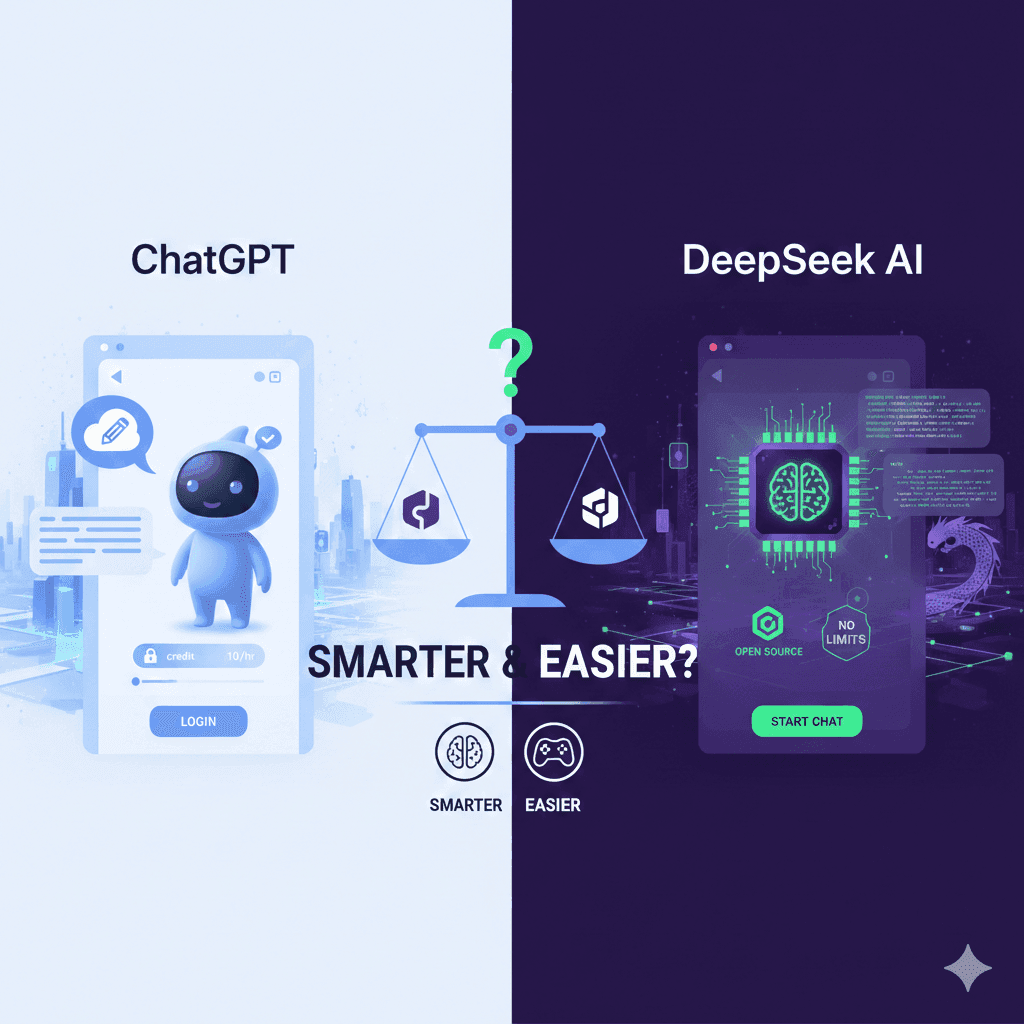
ChatGPT vs DeepSeek are top choices in free AI for beginners. Find out which is smarter and easier to use as we compare their features and limitations.
Choosing the right AI chatbot as a beginner can be challenging. Both ChatGPT and DeepSeek position themselves as free AI for beginners, but each has unique strengths and limitations. In this guide, we’ll directly compare these two platforms to help educators, solopreneurs, and everyday users understand which is actually “smarter” and more suitable for their needs. Let’s explore how they stack up in terms of capabilities, ease of use, and overall value.
ChatGPT is a widely-used AI chatbot developed by OpenAI, known for its conversational skills and helpfulness. Yes – it offers a robust free version that makes it a popular starting point for beginners. With ChatGPT’s free tier, anyone can sign up and start asking questions or getting writing help at no cost. The free version uses OpenAI’s advanced language model to generate answers, though it comes with certain usage limitations (source). For example, free users are limited to about 10 messages every 5 hours under current policies, and some premium features (like unlimited access to the latest models or faster responses) require a paid subscription.
Beginners often find ChatGPT valuable because it’s user-friendly and remembers context within a conversation. You can have a back-and-forth dialog, and ChatGPT will recall earlier parts of the conversation to give relevant answers – a feature that helps when learning or building on previous queries. This memory aspect is a huge advantage for extended learning sessions or project assistance. Whether you’re an educator brainstorming lesson ideas or a solopreneur drafting an email, ChatGPT’s polished and coherent replies make it feel like a helpful assistant.
DeepSeek is a newer AI chatbot that has burst onto the scene as a completely free, open-source alternative to ChatGPT. DeepSeek is considered a “free AI for beginners” because it imposes virtually no usage fees or message limits on users. In fact, you can chat with DeepSeek without even creating an account – just open the app or website and start talking. The platform’s philosophy is to make advanced AI accessible to everyone, so it does not hit users with paywalls, subscriptions, or capped usage (source).
Under the hood, DeepSeek has some serious power. Its flagship models (like DeepSeek V3 and DeepSeek R1) boast performance on par with top-tier systems, enabling it to answer complex questions, generate content, write code, and explain reasoning step-by-step. For example, one of its models (DeepSeek R1) even “thinks” longer to fact-check answers, improving accuracy on difficult questions. This can lead to more accurate answers on tricky questions, which is impressive considering it’s free to use.
Both platforms are designed to be accessible, but there are some differences in ease of use. ChatGPT has a straightforward web interface: you sign up with an email (and phone verification), then you can start chatting in a clean chat window. Once logged in, using ChatGPT feels very much like texting with a knowledgeable friend.
DeepSeek, on the other hand, removes even the sign-up friction. It is arguably the easiest “instant access” experience: you can go to the DeepSeek site or app and start chatting immediately with no registration required. The interface is similarly user-friendly – a simple chat box – and it works smoothly on both desktop and mobile devices. However, ChatGPT supports conversation threads and will keep a history of your chats, whereas DeepSeek treats each chat session independently.
Also, ChatGPT’s responses tend to be more conversational and fluid, which can make interactions feel more natural for beginners, while DeepSeek’s replies can sometimes be a bit more terse or “robotic” in tone. In summary, both are easy to use, but DeepSeek wins on immediate access (no signup, no cost), and ChatGPT wins on long-term user experience (conversation memory and polish).
If your goal is to get help with writing – whether it’s essays, stories, or blog posts – ChatGPT is often regarded as one of the best free AI for writing for beginners. ChatGPT has a knack for producing creative and well-structured text. Beginners who use ChatGPT for writing assistance usually appreciate how human-like and fluent the language is. In fact, ChatGPT is still considered the king when it comes to creative writing or casual conversations, often delivering more natural-sounding prose than its rivals.
DeepSeek is also a powerful writing assistant, but it shines in slightly different areas. It can generate content with plenty of detail, but some users find its writing to be more factual and to-the-point. On the flip side, if your writing task is more technical – say you need to write a piece of code, solve a math problem, or draft a logical explanation – DeepSeek might outperform ChatGPT’s free version. In summary, ChatGPT is usually the smarter choice for general writing due to its more refined style, whereas DeepSeek can be smarter for technical or factual tasks.
Choosing between ChatGPT and DeepSeek ultimately comes down to your personal needs and preferences. Both are powerful free AI for beginners, but they excel in different areas.
Some beginners even choose to use both – ChatGPT for creative tasks and continuous chats, and DeepSeek for intensive problem-solving – to get the best of both worlds.
DeepSeek’s emergence alongside ChatGPT marks a significant shift toward more open and accessible AI. The fact that a free, open-source model can rival a corporate-led chatbot is pushing the industry to become more transparent and affordable. This competition ultimately benefits beginners by lowering barriers – advanced AI is turning into something anyone can use, not just those who pay.
We’ve already seen how a free model like DeepSeek can shake up the market and challenge Big Tech’s dominance, which may lead to more innovation and better offerings for users in the long run.
Looking ahead, we might see basic AI capabilities become as ubiquitous and free as internet access, with premium add-ons offered at a cost. In the big picture, AI is becoming more democratized – and today’s beginners are at the forefront of this new AI revolution.
Both ChatGPT and DeepSeek offer incredible value as free AI tools for beginners, but in different ways. ChatGPT provides a highly refined, user-friendly experience with creative and context-aware conversations, making it an excellent “plug-and-play” assistant for just about anyone.
DeepSeek, meanwhile, delivers raw power and openness – it gives you GPT-4-level intelligence without barriers, which can be a game-changer if you need that extra muscle for complex tasks.
Ultimately, beginners are in a win-win situation – you can start with ChatGPT for a smooth introduction to AI, and explore DeepSeek to push the boundaries once you’re ready.
What is DeepSeek AI?
DeepSeek AI is an open-source chatbot platform that provides free access to advanced large language models (comparable to GPT-4). You can use it without creating an account and even run community-hosted versions if privacy is a concern.
Is ChatGPT really free to use?
Yes, ChatGPT has a free tier available to anyone with an OpenAI account. While it has some message limits, it's fully usable for basic interactions and creative tasks.
Is it safe to use free AI tools like DeepSeek and ChatGPT?
Yes, but with caution. Both platforms have privacy policies. ChatGPT offers settings to limit data usage, while DeepSeek is open-source, allowing privacy-conscious users to host their own version. Avoid sharing personal or sensitive data on any public AI platform.
Key Takeaway: ChatGPT offers an intuitive and creative chat experience for beginners, while DeepSeek provides unrestricted access to powerful tools – try both to see which fits your needs best.
Master advanced prompting techniques 2026 like Chain-of-Thought and Self-Ask to get better results from ChatGPT, Grok, and Gemini.

An accessible overview of the history of artificial intelligence, from early theoretical ideas to modern deep learning.
In 2026, mainstream content creators and new AI adopters have powerful AI video tools at their fingertips.
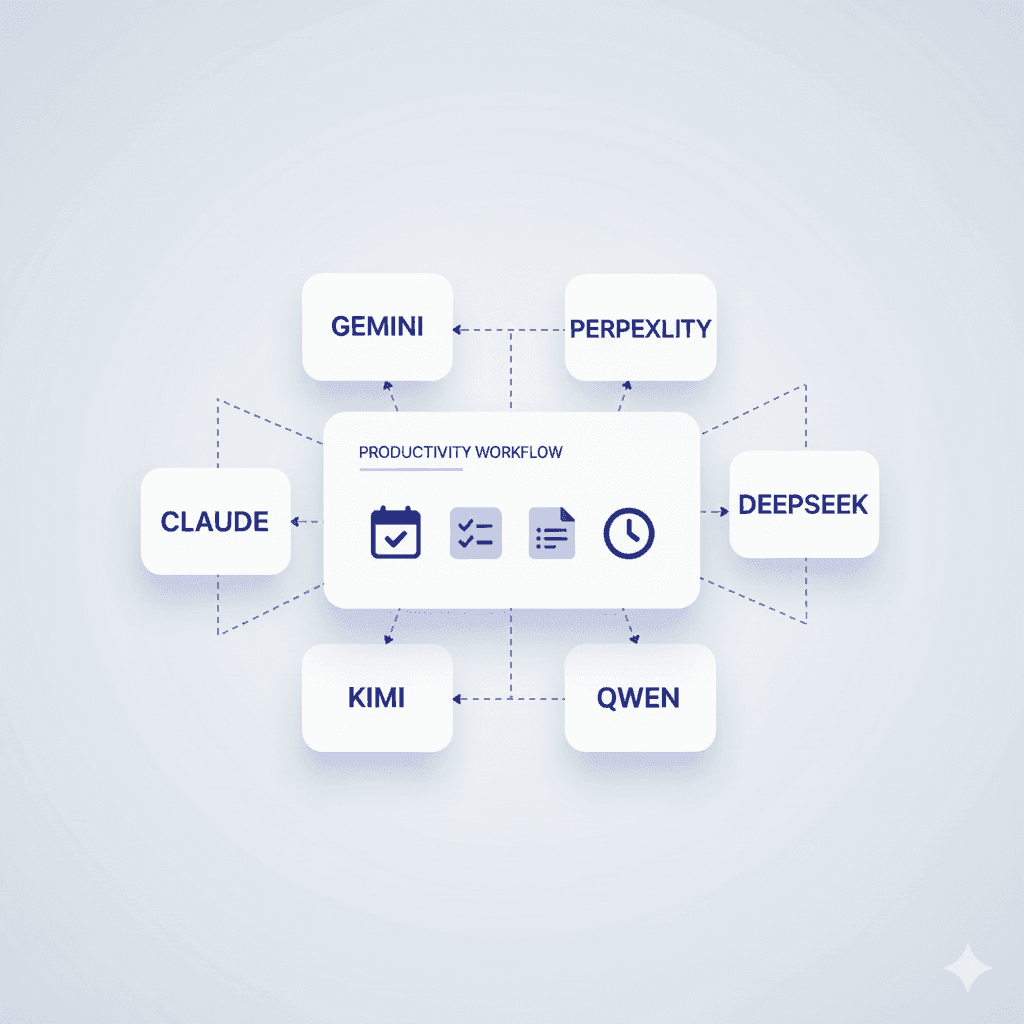
Discover the most powerful AI productivity tools for 2026, including Gemini, Claude, and top emerging alternatives.
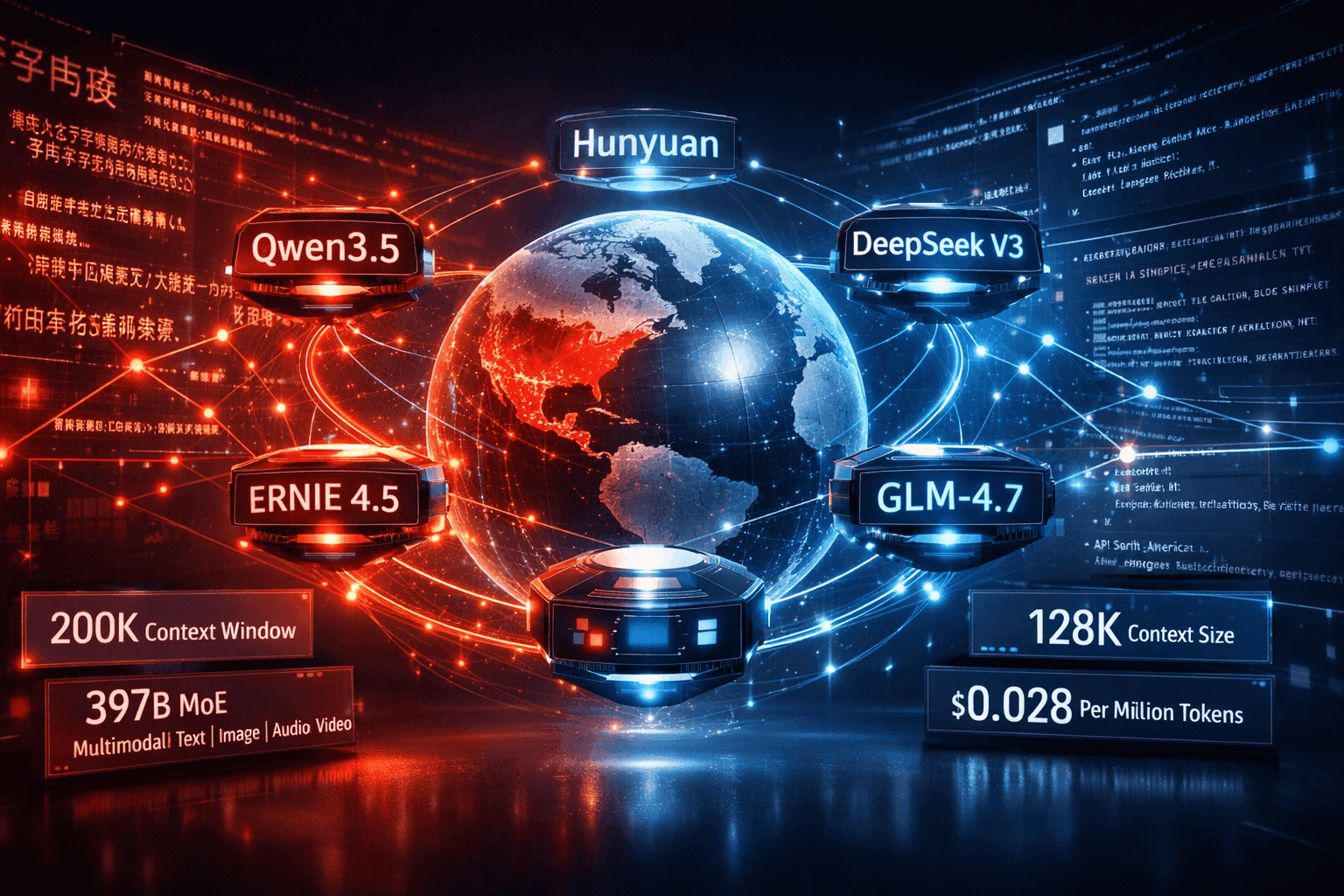
China LLMs 2026: Qwen vs DeepSeek vs ERNIE vs Hunyuan Compared

Machine learning vs deep learning explained with clear differences, real world use cases, and guidance for beginners and professionals

Stop collecting AI tools. Start building a system that works like a fractional employee-automate smarter, not harder.

Explore 12 hands-on AI for Students hacks in 2026—from flashcard tutors to auto-lit reviews—to boost focus, save time, and learn smarter

Muck Rack's 2026 journalism survey found 82% of journalists use AI, up from 77%. But concern about unchecked AI rose 8 points to 26%. Here is what the numbers mean for editorial teams.

The News/Media Alliance signed a 50/50 AI licensing deal with Bria covering 2,200 publishers on enterprise RAG queries. The split sounds equitable. Bria controls the attribution algorithm.

The Dallas Fed's February 2026 analysis shows entry-level positions fell 16% in top AI-exposed industries while experienced workers' wages rose 16.7%. The split is structural, not temporary.

ARC-AGI-3 launched March 26, 2026. Every frontier model scored below 1%: Gemini 3.1 Pro Preview led at 0.37%, GPT-5.4 at 0.26%. Here’s what the interactive agentic benchmark reveals about current AI reasoning limits.

Newsquest runs up to 30 AI-drafted stories a day via 30 AI-assisted reporters. Reuters Institute: 67% of publishers haven't saved jobs from AI yet. Here's what the workflow actually looks like.

Most AI users are still doing prompt engineering in 2026. Context engineering — feeding the right information at the right time — is the upgrade your workflow needs. Two copy-paste patterns included.

The early-user problem in B2B SaaS is solved by manual work, direct relationships, and ruthless prioritization — not marketing funnels or growth hacks. The tactics are well-documented and consistently replicated....

Tech firms blamed 47.9% of 78,557 Q1 2026 layoffs on AI. An NBER survey of roughly 6,000 executives found 90% reported no workforce impact. The gap matters, and this piece explains why.

A beginner-friendly look at how AI may reshape work, health, education, and governance from 2026 to 2031

AI Model Benchmarking: What Claude Sonnet 4.6's Token Surge Reveals

EU Commission missed its February 2026 AI Act guidance deadline. EU Council now proposes pushing high-risk AI enforcement to December 2027. Only 8 of 27 member states have enforcement authorities in place.

Z.ai’s GLM-5 scores 77.8% on SWE-bench Verified and 62.0 on BrowseComp, nearly doubling Claude Opus 4.5’s 37.0. First open-weights model above 50 on the Artificial Analysis Intelligence Index.

EU Digital Omnibus removes mandatory risk assessments for high-risk AI — including hiring tools — and delays August 2026 compliance with no fixed date. Amnesty calls it an unprecedented rollback of EU digital rights.

Three Chinese LLMs — DeepSeek-V3, Qwen2.5-Coder, and Kimi k1.5 — have each made distinct training bets, and the benchmark divergence is now large enough to matter when selecting a model for production. Coding...

Frontier model benchmark scores climbed between 8 and 45 percentage points across MMLU, SWE-bench, and ARC-AGI over the past 12 months. Workflow impact is real but concentrated — reasoning tasks and agentic code...

SWE-bench scores for top coding agents now clear 70%. Inside Databricks' production codebase—millions of lines spanning distributed systems, Scala runtime code, and internal APIs built over a decade—those numbers...

AI-generated disinformation is hitting journalism at its most economically fragile moment in decades. The documented damage — contracting newsrooms, collapsing audience trust, synthetic content that outpaces...
![Elastic Attention Cores for Scalable Vision Transformers [R] image](/_next/image?url=https%3A%2F%2Fbestaifor.s3.eu-west-1.amazonaws.com%2Felastic_attention_cores_for_scalable_vision_transf_featured_7a30bc1faf.jpg&w=3840&q=75)
This paper introduces VECA (Visual Elastic Core Attention), a vision transformer that eliminates direct patch-to-patch attention entirely, replacing it with a fixed set of learned core tokens that mediate all...

memoket-kite is an open-source long-term memory engine for AI agents that eliminates the embedding stack entirely and reports state-of-the-art results on the LoCoMo benchmark. The case against vector-based memory at...